
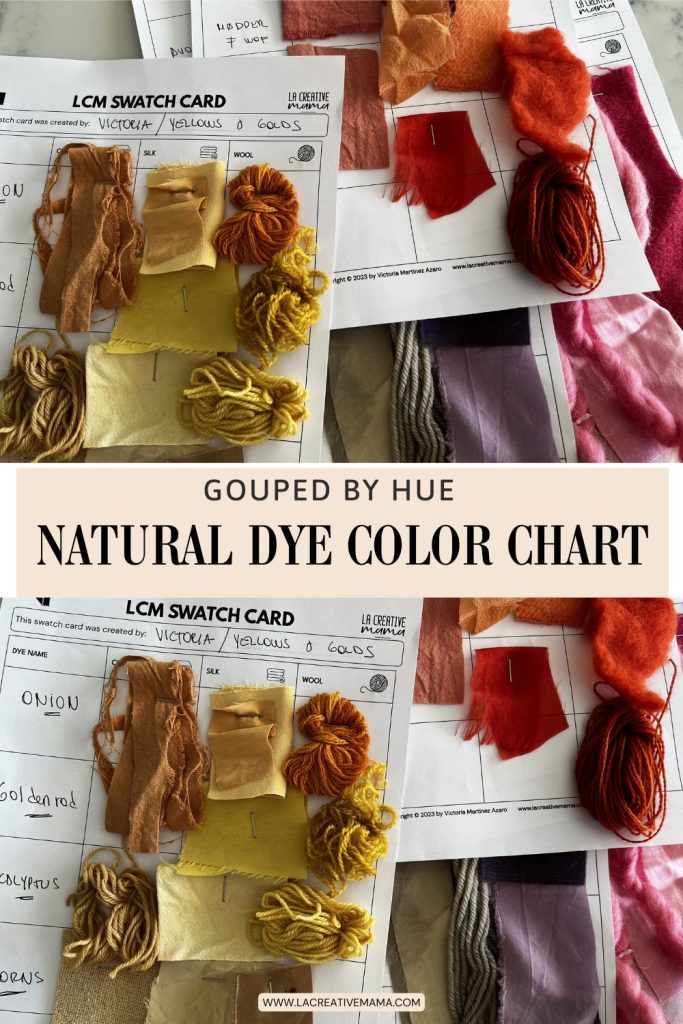
A natural dye color chart groups common dye plants by the hue they produce on mordanted fiber — from bright yellows and warm oranges through dusty pinks, sage greens, rich browns, and deep indigo blues.
The color you get depends on the plant, your mordant, your fiber, and the water in your area.
Hi Creative Mamas!
One of the questions I get asked most often — and one of my favorite questions — is: “What color will this plant give me?”
It sounds like it should have a simple answer. But natural dyeing is beautifully, wonderfully alive. The color you get from a pot of onion skins will look different on wool than it does on cotton. Add a splash of iron water and that golden yellow deepens into moss green.
Use the same pot of coreopsis in summer versus autumn and you might see completely different shades of gold.
But I also know that when you’re starting out, a little predictability goes a long way.
So today I’m sharing a natural dye color chart that gives you a reliable starting point — grouped by color family — so you can plan your projects with confidence and start reaching for the right plants.
What Affects the Color You Get from Natural Dyes?
Before we dive into the chart, it’s worth understanding the four things that most influence your final colour. This is the part that makes natural dyeing so much richer — and more rewarding — than working with synthetic dyes.
1. The dye plant itself Every plant has its own unique mix of color compounds. Some are packed with yellow flavonoids (onion skins and coreopsis).
Others carry tannins that produce warm browns. Indigo is in a world of its own — it’s the only reliable source of true blue from a plant.
2. Your mordant A mordant is the metallic salt that bonds the dye to your fiber. It doesn’t just fix colour — it can completely shift it.
Alum keeps colors bright and clear. Iron saddens and deepens them, often shifting yellows into greens and golds into olives. If you’re not sure where to start with mordanting, my guide to mordant in natural dyeing covers everything.
3. Your fiber Protein fibers (wool, silk, alpaca) absorb natural dyes more readily and tend to give you richer, deeper results.
Cellulose fibers (cotton, linen) need a little more preparation but are absolutely worth it — the colors can be stunning, just softer.
4. Your water Hard water and soft water interact differently with dye baths. If your colors are consistently duller than expected, your water may be alkaline or high in minerals.
It’s one of those lovely variables that makes every dyer’s results uniquely their own.
Natural dyes Video
check out the Youtube video below to see first hand the kind of colorfast colors that you can create from your own home!
Natural Dye Color Chart — Grouped by Hue
Use this as a starting guide. Results shown are for alum-mordanted wool unless otherwise noted and the photos shared are a variety of cotton, linen, wool and silk mordanted with different mordants and recipes. .
Yellows & Golds
The most abundant colour in the natural dye world — and often the most reliable.
| Plant | Typical colour | Notes |
|---|---|---|
| Onion skins (yellow/brown) | Warm golden yellow | One of the strongest natural dyes available. |
| Coreopsis | Bright clear yellow | One of my favorites. Vivid and reliable. |
| Goldenrod | Soft to medium yellow | Seasonal — harvest when fully in bloom for strongest colour. |
| Chamomile | Pale creamy yellow | Gentle and soft. Great for beginners. |
| Marigold (Tagetes) | Golden yellow to orange-gold | Easily grown in the garden. Works well on both wool and cotton. |
| Weld (Reseda luteola) | Clear bright yellow | One of the most lightfast yellow dyes. Historical favourite. |
| Silver Dollar Eucalyptus | Warm honey gold | Also gives eco print results. See Silver Dollar Eucalyptus. |
| St John’s Wort | Soft yellow-gold | Harvest flowers and leaves in summer. |
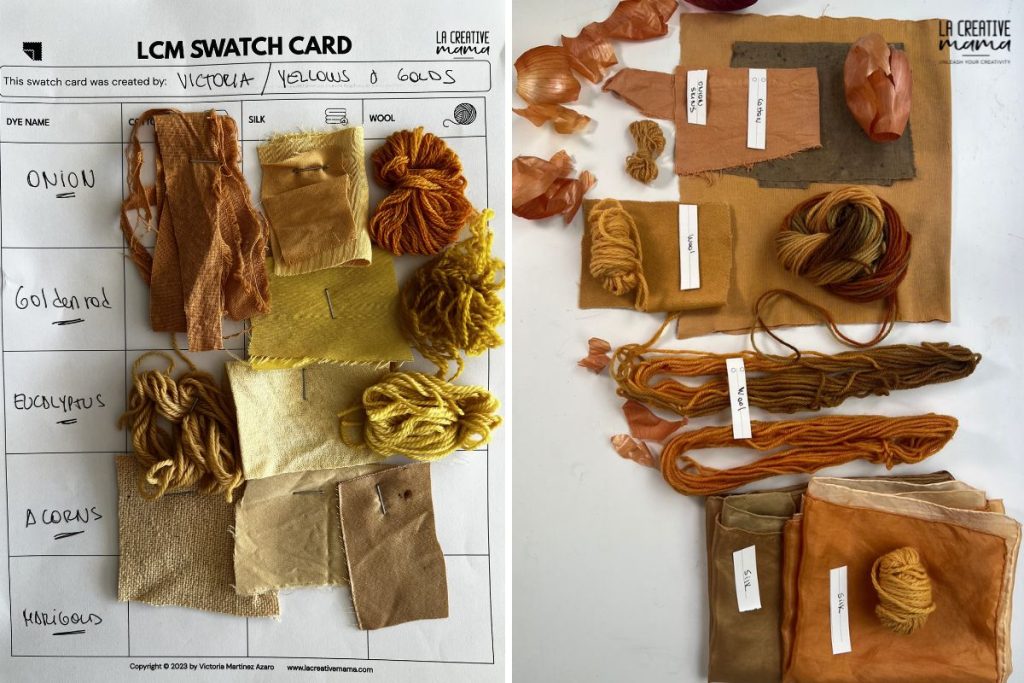
the photo above shows a variety of natural dyes which make neautiful variations of yellows and golds (Onion, goldenrod, eucalyptus, acorns)
Oranges
| Plant | Typical colour | Notes |
|---|---|---|
| Onion skins (red/yellow) | Warm copper-orange | Red and yellow onion skins will deliver a copper orange color if used at higher ratios. |
| Osage orange & quebracho | Deep and intense oranges | I love both these dyes but need to purchase since I don’t have them nearby. |
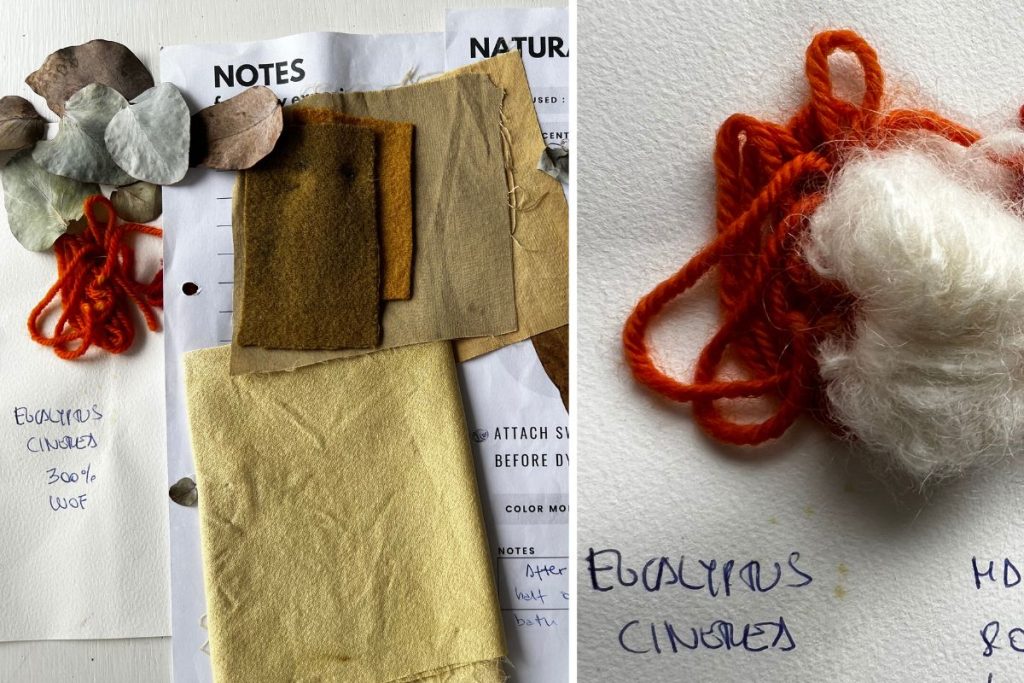
| Silver dollar | Burnt orange | Works wonders on all natural fibers!!!! . |
The photos below show the beautiful orange that you can get from Silver Dollar Eucalyptus at a high intensity.
I have a tree in my garden and I love working with silver dollar for natural dyeing and eco printing.
Pale Pinks & Dusty Roses
Some of the most-searched natural dye colors — and avocado is the star.
| Plant | Typical colour | Notes |
|---|---|---|
| Avocado pits & skins | Dusty pink to blush rose | One of the most beloved natural dyes. Both the skin and pit contribute to the colour. Best on protein fibers. |
| Madder root | Coral pink to soft red | The classic natural red dye. Gives pink /brick colors at lower ratios and intensity. |
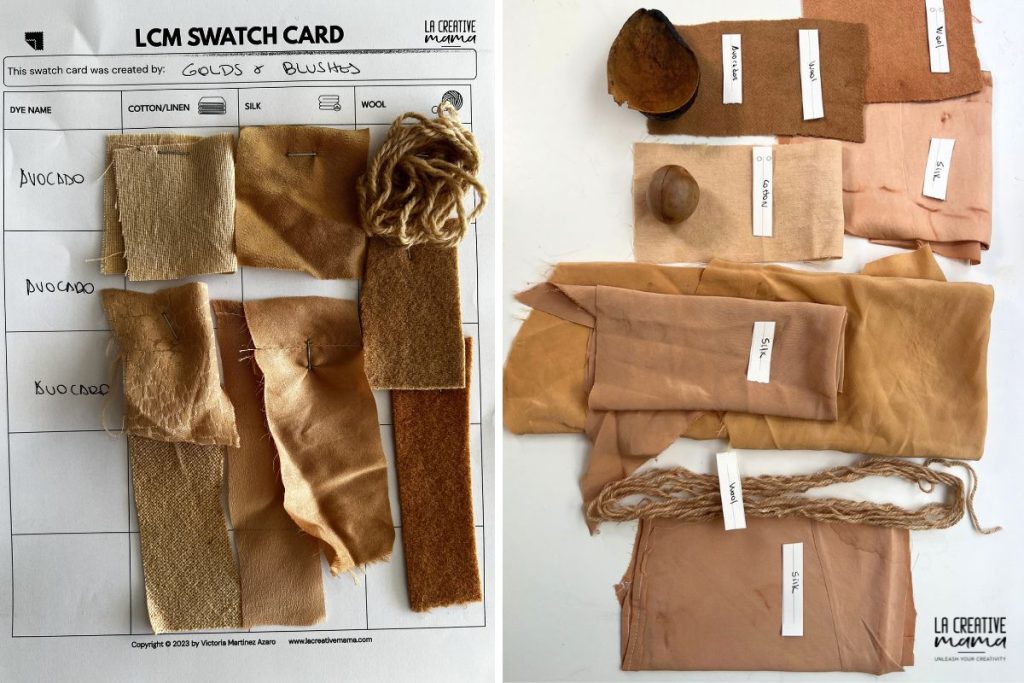
The photo above shows different fibers that were dyed using avocados in different intensity and on different fibers.
Reds, Pinks & Corals
True reds are the holy grail of natural dyeing — madder is your best friend.
| Plant | Typical colour | Notes |
|---|---|---|
| Madder root | Warm red to coral-red | The most reliable natural red. Temperature and mordant significantly affect the result — alum gives the truest red. |
| Cochineal | Vivid red to magenta | An insect dye (not plant-based) but worth mentioning — the most lightfast natural bright pink! |
| Pomegranate rind | Warm gold to ruddy red | I don’t have experience with this dye but some of my students are using it and they love it! |
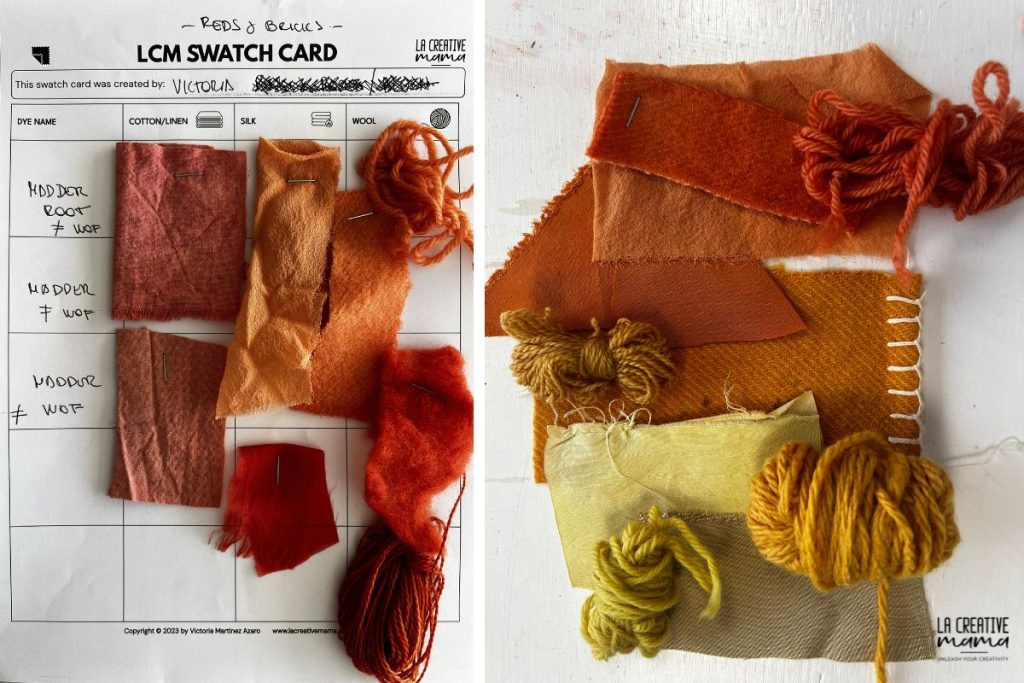
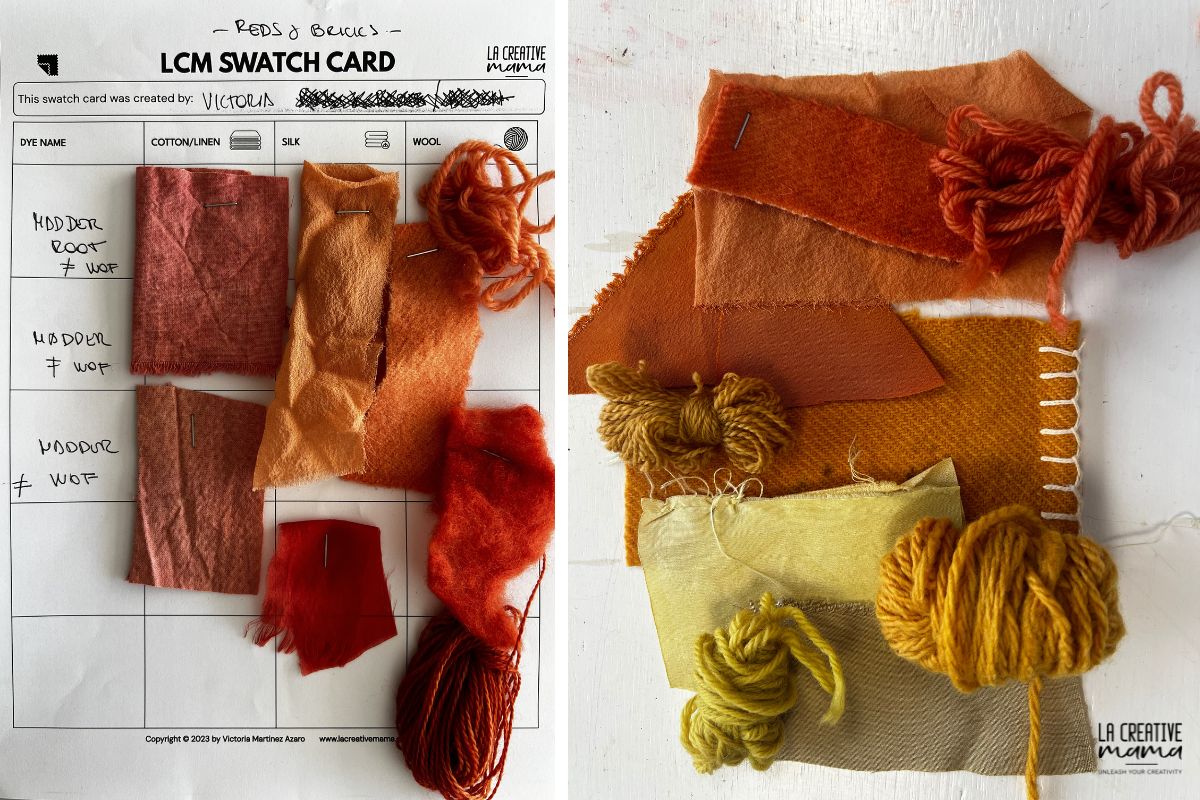
The photo above shows madder as a brick color, an intense orange and an intense red! Very diverse colors can be achieved!
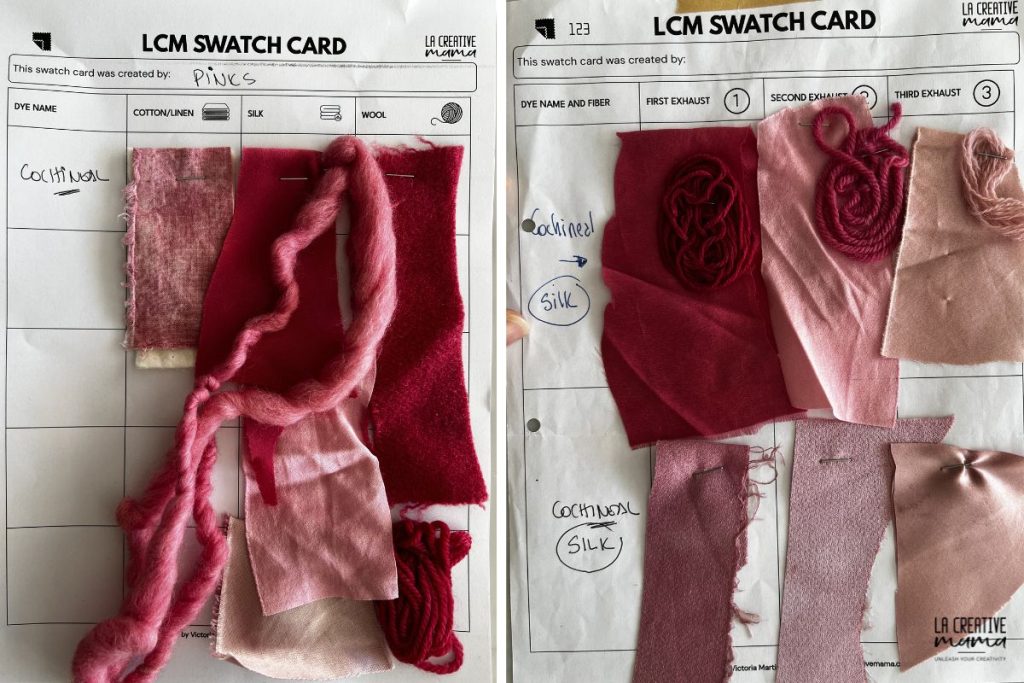
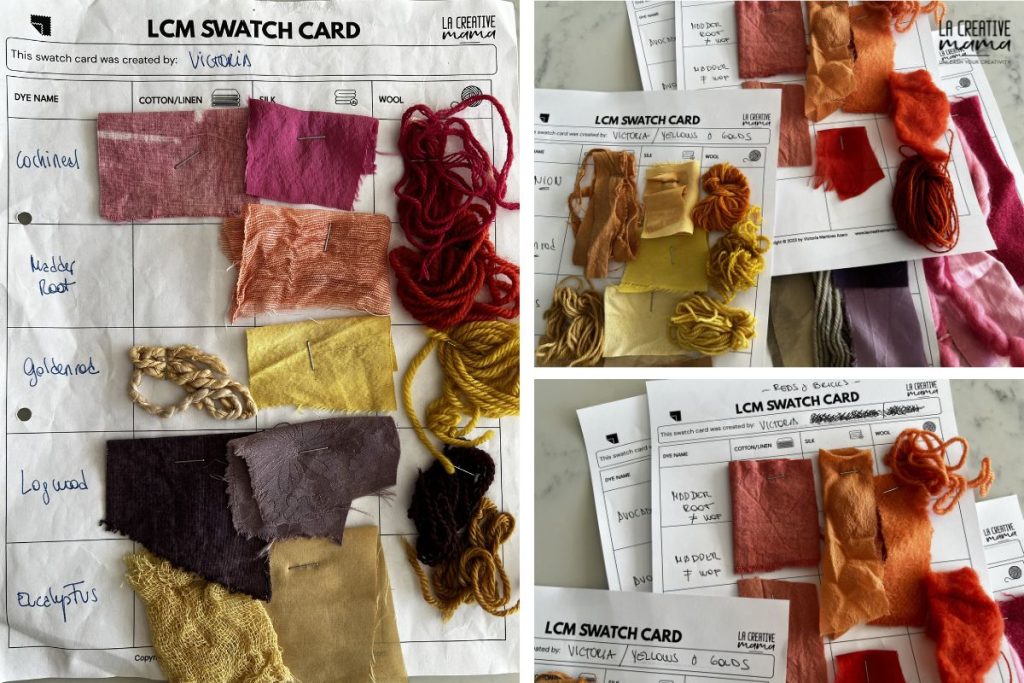
The photo above shows cochineal dyed silk , wool and cotton (left) and a variety of samples on silk and wool (right) that produced lighter and lighter colors by re using the dye bath again and again!
Greens
Green is rarely achieved directly — most natural greens are created by overdyeing or using iron as a modifier.
| Plant | Typical colour | Notes |
|---|---|---|
| Nettles | Soft olive green | Fresh or dried nettles give a gentle herbaceous green. |
| Bracken fern | Yellow-green to khaki | Young fronds give brighter results. |
| Mate: Yellow dye plant + iron modifier | Olive to forest green | The most reliable route to green: dye yellow first (coreopsis, goldenrod, onion), then shift with iron water. |
| Japanese indigo (fresh leaves) | Cool soft green | Different process to vat indigo — bundle or immersion in fresh leaf juice. |
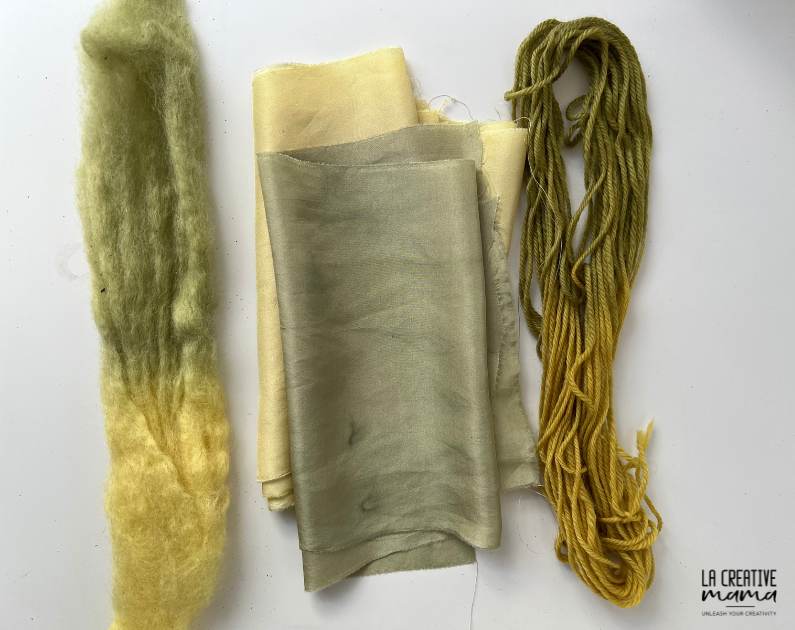
The photo above shows silks and wools which were dyed using mate to create a yellow and then modified with iron to create green!
Blues
Indigo is the king of natural blue — nothing else comes close for depth and reliability.
| Plant | Typical colour | Notes |
|---|---|---|
| Indigo (vat) | Pale sky to deep navy | The only plant source of true, lasting blue. Requires a reduction vat — no mordant needed. Results vary by number of dips. |
| Woad | Soft blue-grey | European cousin of indigo. Lower concentration of pigment — gives lighter blues. |
| Japanese indigo | Soft teal-blue | Fresh leaf method gives softer results than vat. |
Browns, Tans & Beiges
Some of the most lightfast – colorfast natural dyes — and often the easiest to achieve.
| Plant | Typical colour | Notes |
|---|---|---|
| Walnut (hulls) | Deep chocolate brown | Substantive — no mordant needed. Powerful. Will stain skin and hands. |
| Black tea | Warm beige to tan | A beginner’s first dye. Substantive and reliable. Excellent on cotton. |
| Coffee | Warm brown | Similar to tea — easy and kitchen-accessible. |
| Oak bark / oak galls | Warm tan to grey-brown | High tannin content makes it great for cotton pre-treatment too. |
| Eucalyptus (various species) | Tan to warm russet-brown | Species and season affect result significantly. |
Purples & Greys
These are my favorites because you can have a lot of fun and create a lot of variety!
| Plant | Typical colour | Notes |
|---|---|---|
| Elderberries | Soft purple-lavender | Very fugitive — lovely results but fades in sunlight over time. Fun to test with kids. Great for non-wearables. |
| Blackberries | Dusty mauve-purple | Similar fugitive behavior. Great for non-wearables. |
| Iron modifier (on any dye) | Grey to charcoal | Not a dye plant — but iron water applied as a post-mordant shifts almost any colour toward grey. |
| Logwood | Deep marron, purple and lavender | The best source of amazing purples! |
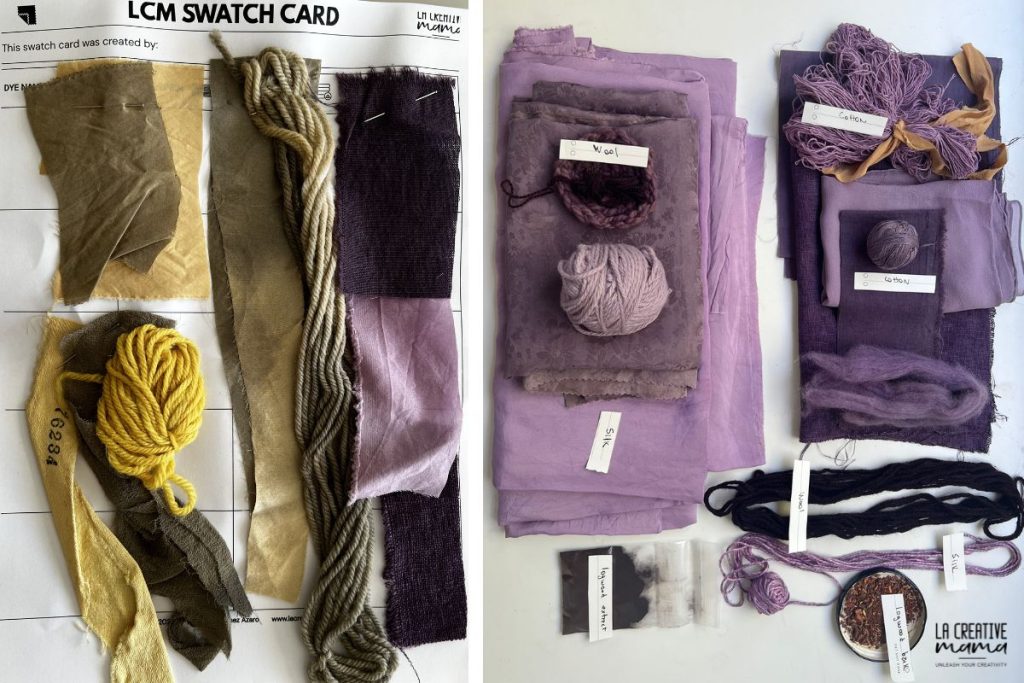
The photo above shows modifications on eucalyptus and acorns (from yellows and golds to greys) and purples from Logwood dye.
A Note on Lightfastness – (colorfast dyes)
Not all natural colours are equal when it comes to fading. Some — like walnut, indigo, and weld — are beautifully lightfast. Others — like blackberry, elderberry, and hibiscus — are fugitive, meaning they’ll fade in sunlight over time.
This doesn’t mean fugitive dyes aren’t worth using. It just means they’re better suited to items kept out of direct sunlight — think cushion covers, art yarn, or decorative textiles rather than everyday clothing you’ll wear in the sun.
Inside the Natural Dyeing Ultimate Course, I cover lightfastness in depth — including how to test your own results and which mordant choices give you the most lasting colour.
Want a Reliable Framework for All of This?
A colour chart gives you the map. But knowing how to reliably get those colours — with confidence, not guesswork — is a different skill.
That’s exactly what the Natural Dyeing Bundle is for. It’s the perfect starting point: a curated collection of my best beginner resources to help you start natural dyeing with clarity and joy — without the frustrating “why didn’t it work?” moments.
If you’re ready to go deeper — full mordanting process, my Formula Calculator, plant-by-plant guides, and step-by-step video lessons — the Natural Dyeing Ultimate Course is where it all comes together.
Over 800 students have been through it, and the thing they tell me most is: “I wish I’d started with a system sooner.”
A natural dye colour chart is a reference guide that shows which plant materials produce which colours on natural fiber. It groups dye plants by the hue they give — yellows, pinks, blues, greens, browns — so dyers can plan their projects and choose their plants with more confidence before they start.
Coreopsis, onion skins (yellow/brown), and weld are three of the most reliable sources of bright, clear yellow. Coreopsis in particular gives a vivid, saturated yellow that’s hard to beat. Goldenrod and chamomile give softer, more muted yellows.
Avocado pits and skins are the most popular source of pink in natural dyeing — they give a beautiful dusty rose or blush colour on alum-mordanted wool and silk. Madder root can also give pink at lower temperatures. Results vary by fiber type and mordant.
True green directly from a plant is rare. The most reliable route to green is overdyeing — dye yellow first (using coreopsis, goldenrod, or onion skins) and then shift the colour with iron water as a post-mordant. The iron saddens the yellow into a beautiful olive or forest green.
Indigo is the only reliable plant source of true, lasting blue in natural dyeing. It requires a reduction vat rather than a standard dye bath, and no mordant is needed. Woad is a European alternative but gives softer, lighter results.
Protein fibers (wool, silk, alpaca) and cellulose fibers (cotton, linen) absorb dye molecules differently. Protein fibers typically give richer, more saturated results. Cellulose fibers may need additional preparation — like tannin pre-treatment — to achieve similar depth.
Yes, significantly. Alum mordant generally gives the truest, brightest version of a plant’s color. Iron shifts colors darker and toward green-grey tones. This is why two dyers using the same plant can end up with entirely different results depending on their mordant choice.
No — natural dyes vary widely in lightfastness. Indigo, weld, and walnut are among the most lightfast. Elderberry, blackberry, and hibiscus are more fugitive and will fade with prolonged sun exposure. Mordant choice and storage conditions both affect how long a color lasts.
Want More Plants Like This?
More Natural Dyeing Guides You’ll Love
- Mordant in Natural Dyeing: What It Is & Why It Matters
- Natural Dyes That Don’t Need a Mordant
- Best Mordants for Eco Printing Fabric
- Plants That Dye: Silver Dollar Eucalyptus
- Plants That Dye: Goldenrod
Hi, I am Victoria!
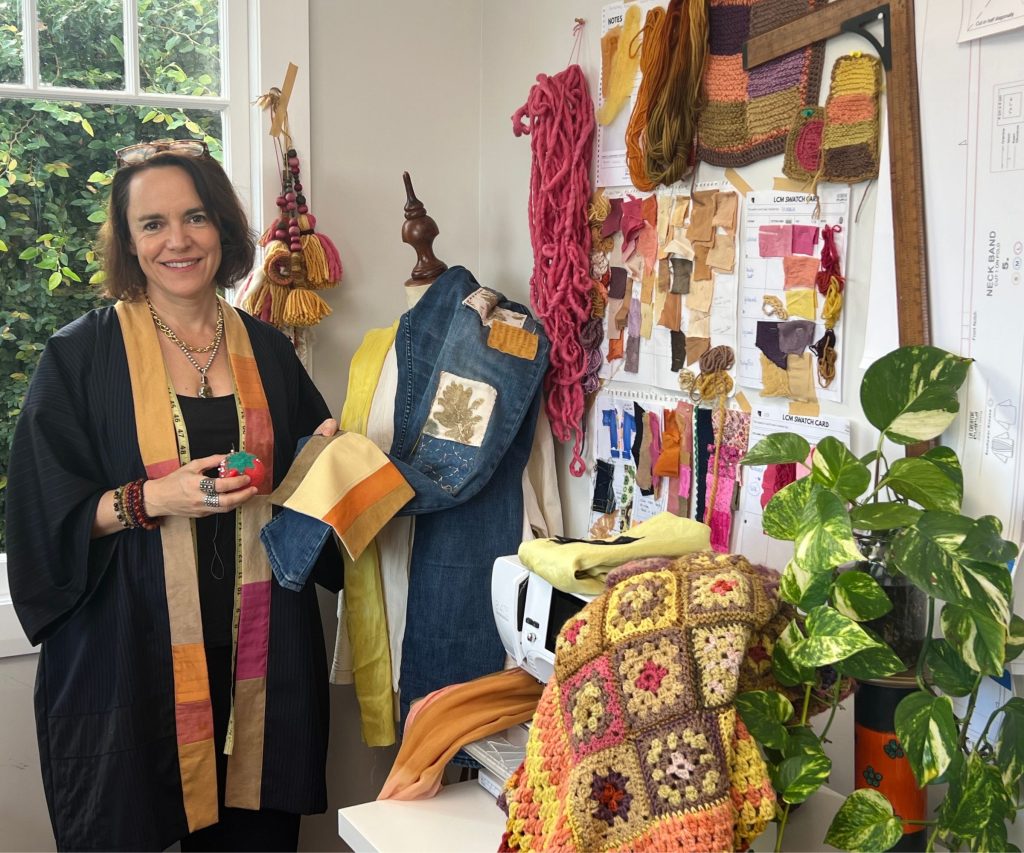
Welcome to my creative world!
I created LA CREATIVE MAMA as a crafty home for all my crafty talented friends who want to get inspired and creative with DIY sewing projects, upcycled fabric crafts, natural dyeing, eco printing and of course my favorite: DIY Sustainable FASHION!
Get in touch!
Join me and the community of Creative Mamas! Come over to Facebook / Instagram/ Pinterest and leave a comment or reply to a blog post here.
Would love to see any pics from projects you did from my blog and I can feature you here!
Thank you for this lovely dye chart. I wish I had the time.
Is this available in a document form for me to keep for another year?
Thank you.
Not for now sorry, but this post will remain live for you to come to it 🙂